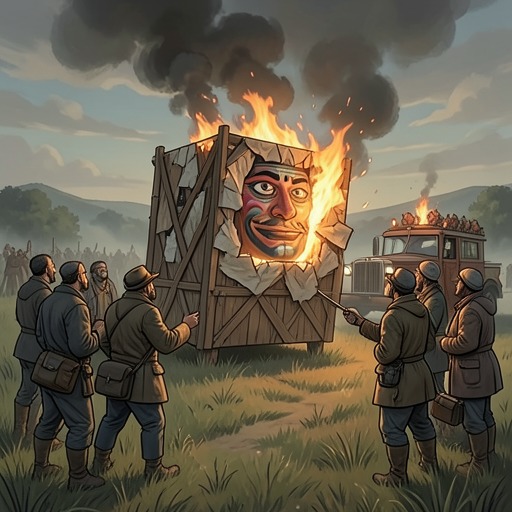
Founder’s Day prank
Clown in a CornfieldThe Founder’s Day prank was an act of defiance amid a town festival that briefly looked like harmless entertainment. Its crowd-pleasing sparks and pops stood in sharp contrast to the effort by Kettle Springs’ leaders to control which young people belonged at the celebration. Sheriff George Dunne later presented the stunt as the trigger for urgent action by the secret Kettle Springs Improvement Society, giving a moment of mischief a darker political afterlife.
Background and Public Tension
At a town meeting before the festival, a resident asked Sheriff George Dunne about the Baypen investigation and the dropped charges against Cole Hill. Dunne declined to discuss the case officially, then spoke off the record about a widening gap between what was legal and what he considered right. He said the town might soon face a moment when the law could not preserve Kettle Springs as its residents knew it, and invoked science teacher Mr. Vern’s efforts to discourage certain students from attending the next day’s event.
Dunne framed that exclusionary appeal through the town’s accumulated losses. He pointed to Arthur Hill’s child having died the previous year, the recent fire at Arthur’s factory, Kettle Springs’ declining population, and his claim that young people cared nothing for local history or heritage. He argued that the new generation needed to be brought into line and urged the assembled adults to act rather than wait for rescue. Harlan Jaffers tried to reclaim the meeting, but Dunne’s appeal held the audience. The prank took place in a climate where adult anxiety about the town’s future was already being directed at its young people.
The Festival and the Prank
Quinn Maybrook had been reluctant to attend Founder’s Day and had no good explanation ready for her father for why she might skip it. After an hour at the festival, however, nobody had approached to ask her to leave or tell her she was banned. The event was larger than she had expected: food and music drew a crowd apparently augmented by visitors from neighboring towns, while a small carnival occupied the school parking lot, its rides and midway games brought in on trailers.
During the parade, sparks and sharp popping sounds began along the route. The volunteer firefighters looked at one another, bewildered, unsure how to respond. Many in the crowd took the commotion for part of the show and clapped and cheered. Quinn knew it was not on the official program, but smiled too. The narration presents the stunt as a possible act of defiance engineered by Janet Murray, while emphasizing its immediate effect: for the people watching, it was still fun, and it gave them joy. The prank’s public meaning therefore diverged from its unofficial intent; the crowd could enjoy the disruption without recognizing it as a challenge to the town’s management of the day.
From Defiance to Pretext
The festival’s cheerful surface gave way to more dangerous scenes as the day progressed. At the later cornfield party, Quinn, Cole Hill, and Janet reached a clearing beside a disused barn and a leaning silo. Inside the crowded barn, heat built after several songs even with both doors open. When the attack began, partygoers struggled to escape: most moved toward the corn or tried to get into the barn as others worked to close its large wheeled doors. The confusion culminated in Erin Werther being struck by a bolt at the silo entrance and killed. These events mark a violent contrast with the festival crowd’s earlier belief that the parade’s sparks and pops were simply part of the entertainment.
Later, while driving Cole away from town, Dunne assigned the Founder’s Day stunt a strategic role in the violence. He said it had made people think they needed to act quickly, but also described the Kettle Springs Improvement Society as the product of months of recruitment and selective disclosure. The prank, in his account, did not create the Society; it supplied urgency to a conspiracy already being assembled. Dunne said Dr. Weller, once an outspoken supporter, had threatened to expose the group and that its members had dealt with the threat together.
Retrospective Significance
Dunne’s explanation links the prank to a broader effort to portray young people as a danger to the town. He described them as a blighted crop that had to be cut out or burned to save the land, and treated their supposed moral defect as more important than whether phones, the internet, music, or social media had caused it. Cole answered that the adults’ nostalgia and refusal to listen to younger residents were part of the conflict. The contrast exposes how a harmless-seeming public disturbance could be recast as proof of a generational crisis.
The prank’s significance lies partly in that change of scale. For festivalgoers, an unscheduled burst of noise and light became a source of shared amusement; for Dunne, it became evidence that the town must act, and a reason to hurry a plan already under way. His later account reveals the political use made of the stunt without making his justification neutral: the Society’s campaign targeted an entire generation, while its leaders presented their own decision to use violence as a response to youthful disorder.